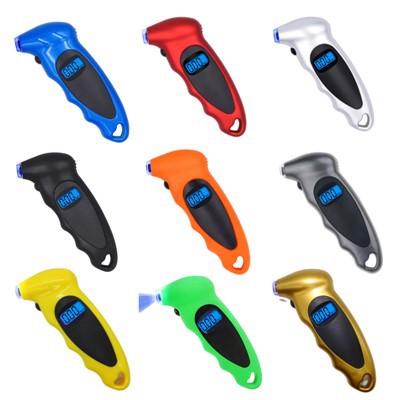
Hey there! As a supplier of ball pressure gauges, I often get asked a really interesting question: "Can a ball pressure gauge be used to measure the pressure of a refrigerant?" Let's dig into this topic and find out.
First off, let's understand what a ball pressure gauge is. A ball pressure gauge is a simple yet effective tool. It's mainly used in a variety of applications where measuring pressure is crucial. We offer different types of ball pressure gauges, like the Pocket Size Dual Foot Gauge, the Standard Passenger Tire Gauge, and the Straight On Deluxe Tire Gauge. These gauges are well - known for their accuracy and durability in measuring tire pressure. But can they handle refrigerant pressure?
Refrigerants are substances used in refrigeration and air - conditioning systems. They work by undergoing phase changes (from liquid to gas and back) to transfer heat. The pressure of refrigerants in these systems is a critical parameter. It affects the efficiency and performance of the entire system. Refrigerant pressures can vary widely depending on the type of refrigerant, the operating conditions of the system, and the specific application.
Now, let's talk about the design and function of a ball pressure gauge. A ball pressure gauge typically consists of a housing, a ball that moves in response to pressure, and a scale to read the pressure value. When pressure is applied, the ball is pushed against a spring or some other resistance mechanism, and the position of the ball on the scale indicates the pressure.
One of the main factors to consider when thinking about using a ball pressure gauge for refrigerant pressure is the pressure range. Refrigerant systems can operate at very high pressures, sometimes reaching several hundred pounds per square inch (psi). Our standard ball pressure gauges, like the ones used for tires, are designed for much lower pressure ranges. For example, a typical tire pressure might range from 30 to 50 psi, while a refrigerant system could have pressures well above 200 psi. If you try to use a tire - rated ball pressure gauge on a high - pressure refrigerant system, the gauge might not be able to handle the pressure. The ball could be forced out of the housing, or the internal components could be damaged, leading to inaccurate readings or even a safety hazard.


Another important aspect is the compatibility of the gauge with the refrigerant. Refrigerants can be corrosive or reactive with certain materials. The materials used in a ball pressure gauge, such as the housing, the ball, and the seals, need to be compatible with the refrigerant. If the materials are not compatible, the refrigerant could cause the gauge to deteriorate over time. This could lead to leaks, inaccurate readings, or even failure of the gauge.
However, there are some situations where a ball pressure gauge might be used for refrigerant pressure measurement, but only under very specific conditions. If the refrigerant system operates at relatively low pressures, and the ball pressure gauge has a suitable pressure range and is made of compatible materials, it could potentially be used. For example, in some small - scale or low - pressure refrigerant applications, a modified ball pressure gauge might work.
But in most professional refrigeration and air - conditioning applications, specialized refrigerant pressure gauges are used. These gauges are designed specifically for the high pressures and unique properties of refrigerants. They are calibrated to provide accurate readings in the specific pressure ranges of refrigerant systems. They also use materials that are resistant to the corrosive effects of refrigerants.
So, to sum it up, in general, a standard ball pressure gauge used for tires is not suitable for measuring the pressure of a refrigerant. The pressure range and material compatibility are major issues. However, with proper modification and under specific low - pressure conditions, a ball pressure gauge could potentially be used.
If you're in the market for a pressure gauge, whether it's for tires or other applications, we've got you covered. Our ball pressure gauges are of the highest quality, and we offer a wide range of options to meet your needs. If you have any questions about our products or are interested in purchasing, feel free to reach out. We're always happy to have a chat and help you find the right gauge for your specific application. Let's start a conversation and see how we can work together!
References
- General knowledge of pressure gauge design and function
- Understanding of refrigeration and air - conditioning systems and refrigerant properties