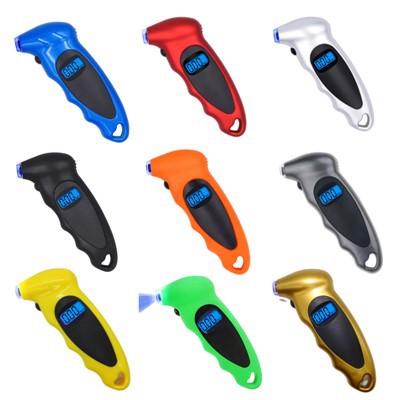
Hey there! As a supplier of Mini Tire Gauges, I often get asked about the response time of these nifty little tools. So, let's dive right in and talk about what the response time of a Mini Tire Gauge is all about.
First off, what exactly do we mean by "response time" when it comes to a Mini Tire Gauge? Well, it's the time it takes for the gauge to give you an accurate reading once it's connected to the tire valve. You know, when you pop the gauge onto the valve stem, how quickly does it show you the correct tire pressure? That's the response time.
Now, why does the response time matter? Imagine you're in a hurry, maybe you're running late for work or you're on a road trip and you just want to quickly check your tire pressure. You don't want to stand there waiting forever for the gauge to give you a reading. A fast response time means you can get the information you need and get on with your day.
There are a few factors that can affect the response time of a Mini Tire Gauge. One of the main ones is the type of mechanism inside the gauge. Some gauges use a simple mechanical system, while others are more high - tech and use electronic sensors.
Mechanical Mini Tire Gauges are the old - school type. They usually have a spring - loaded piston or a diaphragm that moves in response to the air pressure in the tire. When you connect the gauge to the valve, the air from the tire pushes against this mechanism, and it moves a needle on the gauge face. These gauges can be pretty reliable, but their response time can vary. Sometimes, they might take a little longer to stabilize and give an accurate reading, especially if the tire pressure is very high or very low.
On the other hand, electronic Mini Tire Gauges are the new kids on the block. They use sensors to measure the air pressure and then display the reading on a digital screen. These gauges tend to have a faster response time because the sensors can detect the pressure changes more quickly. They also often have a higher level of accuracy, which is a bonus.
As a supplier, I've tested a bunch of different Mini Tire Gauges to see how they perform in terms of response time. And let me tell you, there's a big difference between the best and the worst. The really good electronic gauges can give you a reading in just a few seconds. That's super quick! You barely have time to blink before you know the tire pressure.
But it's not just about the technology. The quality of the materials used in the gauge also plays a role. A well - made gauge with high - quality components is more likely to have a consistent and fast response time. Cheaper gauges might cut corners on the materials, which can lead to slower response times and less accurate readings.


Let's talk a bit about the different types of Mini Tire Gauges we offer. We have the Standard Passenger Tire Gauge. This is a great all - around gauge for everyday use. It has a nice balance between price and performance. The response time is pretty decent, and it gives accurate readings for most passenger cars.
Then there's the Straight On Deluxe Tire Gauge. This one is a step up in terms of quality. It's made with better materials and has a more precise mechanism. The response time is faster, and it can handle a wider range of tire pressures. If you're looking for a gauge that's going to give you quick and accurate readings every time, this is a great option.
And for those on a budget, we have the Economy Tire Air Gauge. It's an affordable choice, but don't let the price fool you. It still does a good job of measuring tire pressure. The response time might not be as fast as the more expensive gauges, but it's still perfectly usable for occasional tire checks.
So, how can you tell if a Mini Tire Gauge has a good response time? Well, one way is to read reviews from other customers. People who have used the gauge will often mention how quickly it gives a reading. You can also look at the specifications provided by the manufacturer. Some manufacturers will list the approximate response time in their product descriptions.
Another thing to keep in mind is that the response time can also be affected by the temperature. In cold weather, the air inside the tire contracts, and the gauge might take a little longer to adjust to the pressure. In hot weather, the air expands, and the gauge might give a reading a bit more quickly. But these differences are usually pretty small.
In conclusion, the response time of a Mini Tire Gauge is an important factor to consider when you're buying one. A fast - responding gauge can save you time and give you more accurate information. Whether you're a casual driver who just wants to check your tire pressure once in a while or a professional mechanic who needs to make quick and accurate readings all day long, there's a Mini Tire Gauge out there for you.
If you're interested in purchasing any of our Mini Tire Gauges or want to learn more about them, feel free to reach out to us. We're always happy to answer your questions and help you find the right gauge for your needs. Let's get your tires in top shape!
References
- Various industry reports on tire gauge technology
- In - house testing data of Mini Tire Gauges